Jennifer Finch: Inspiring the revolution

It’s 1992 and it’s the Reading Festival. The now legendary Reading festival, I should say.


Nirvana, Public Enemy, The Wonderstuff, Nick Cave, Rollins Band, Teenage Fanclub, L7, PJ Harvey, PIL, Beastie Boys, The Charlatans, Manic Street Preachers, Ride, Pavement, Melvins, Mudhoney, Smashing Pumpkins, The Farm…


Anything stand out…? 


L7 seemed to be bulletproof in the early ‘90’s. After their self-titled debut in 1988, the follow up album, Smell The Magic, hit the shelves in 1990. Nobody will ever convince me that this is not one of the great punk rock records both stylistically and in attitude. It’s a killer. The legendary line in Fast and Frightening “got so much clit, she don’t need no balls”, seemed to be written for every misogynist that was sleazing around the industry and for all the women who came along later to find the same shit, just a different day. They released Bricks Are Heavy in 1992 and with MTV VJ’s going into a tailspin over Pretend We’re Dead, the Lollapolooza festival was beckoning. 


With our love of genre-fying anything that breathes, L7 got chucked in with grunge. Too easy, too lazy, too divisive – especially now. Sure, grunge helped in some positive ways, but equally, the “end” probably didn’t help. I don’t know whether the Reading festival was the band’s plateau moment. It didn’t feel like it to me personally but that’s just my own experience. To me, they were never anything else apart from L fucking 7. Four women with a punk attitude who just rocked the fuck out, infiltrated the system from the underground and broke down barriers. I loved everything they stood for. Still do.


Ahead of their time, misunderstood and severely overlooked.


Since the age of 13, Jennifer Finch had been taking her Pentax camera and documenting her experience of the culturally significant and volatile Los Angeles punk rock scene – the musicians, the fans, the scenesters. Jennifer joined L7 in 1986 when she was 20 years old. She continued to document her life on the road with L7 and her archive reached around 9,000 images – a vast body of work that she recently saved from the creep of time and digitised the lot. It’s a culturally priceless collection of a significant period in rock music history.


The seminal experience of hanging out in that punk rock scene has helped guide Jennifer through life. She has always created her own rules built on her values and the ethos of DIY. She’s a musical performer. She’s a photographer. A computer science grad. A web designer. A gamer. A brand strategist. 


But more than anything, she’s a deeply thoughtful and empathetic community builder.


When she immerses her whole self on stage, she’s visceral, invincible and unifying. You would not think that intense stage fright was an unwelcome companion in her younger years. 


Giles Sibbald: In the past decade, more people have started designing their own working lives, shifting priorities when needed, doing side hustles, using different skillsets, and you’ve been pioneering this life for years. What influenced you as a kid that ultimately led you to get into so many different things?


Jennifer Finch: One of my earliest memories is that question that children are asked – ‘what do you want to be when you grow up?’ I’d say like ‘I want to be a veterinarian’ because I loved animals and they would say things like, ‘Well, that’s a lot of schooling’, and I remember being young and just thinking ‘Why are you ruining this? Like, what part of your power trip are you on that’s ruining it?’ I mean, I didn’t have that wording, of course, like just that feeling. And I can remember very distinctly at about age nine or 10, maybe 11, when the brain is like questioning, thinking ‘Why am I picking one thing to be? Why can’t I be a sailor and a ballerina? Like, what’s so conflicting that I couldn’t be both? I grew up in the 60s and 70s when you were really just one thing. 


But one of the super lucky things that happened to me when I was little was being adopted. And my parents always told me I was adopted and they wanted me to to interface with other kids that were adopted, so that it would just be ‘some kids are adopted and some kids aren’t’. So what happened with that was I played with other kids who might have two moms or I played with kids that had different complexions and cultural backgrounds. So I was exposed to a type of diversity where I identified with love and family and not sexual identity and not racial identity. So I think that was one very formative thing where I was like, ‘we can be diverse’. 


When I was into the school system, I was faced with kind of this single direction, very traditional school system. I kind of have this like ‘why is it homogenised in my class? Why are all the 5 year olds together and the 12 year olds are together?’ And then through my experiences, I eventually couldn’t go to school anymore. I had no interest in school from the ninth grade. And my father put me into home schooling, so I was very self directed. And all of a sudden, I had choices on direction. So when they said ‘you have to take a science class – which was always traumatic to me – I was the kid that was like at 13 going, ‘I’m not dissecting a frog’. I didn’t have an entry into the sciences or into maths because it was not, you know, acceptable, so I did have home schooling until what we call the 12th grade in the US, which is like 16, 17, right before you’re going to move forward into like a bigger, institutionalised education. And it was great for me. I flourished under it. So my lives were very separate. I understood different groups. I understood that a person can wear many hats in their life, you know, like you have family life, you can have work life, you can have school life.


GS: I mean staying in that traditional school system back then – which is what I did – encouraged you to then follow the 3 stage “education, work, retire” model, which is basically redundant now. But education-wise you just flourished under a more self-directed, individualistic approach, right?


JF: Yeah, I mean I’ve been an avid gamer since I’ve been little. I’ve been in the digital space since the early ‘80’s, I went to San Francisco State for computer science and things like message boards and the idea of what later became, I’m going to say HTML, was always fascinating to me, almost maybe a hobbyist kind of way. 


And then L7 needed a bass player. So I kind of left and then revisited it in the 90s after I’d left L7. The first thing was understanding that I wasn’t necessarily a musician, but I was a content provider, that it was about lifestyle and personality. I mean, the first thing I did was build my writing skills – which I think was completely lost at some point – and communication skills, like I said, always have been important, but back then, the only books I can remember dipping into would have been Franklin Covey’s ‘What Matters Most’ which was really, really influential – the idea of being able to establish my values and start to make to do lists based on my values and what matters. The thing that came up through punk rock with me was this very personal, hang on, integrity, drive – all these really great attributes – but sometimes it made it really difficult to just wake up and say, you know, I need to make 40 bucks today, or I can’t pay my electric, you know? 


GS: But until the system changes, there’s still an economic imperative to make some money unless you’re gonna sit totally outside the system.


JF: Right. And as an artist in the ‘80s and ‘90s, it was all ideas and not the production side. And as a musician growing up then, you’re reliant on other people to be your creator. You co-create with people that have the tech side and that division was very apparent, which is something completely different now. You have the idea that you’re your own producer and editor or you’re on your own podcast as the engineer and the personality. 


GS: So, you went from collaborating with your co-creators to then saying, OK, there’s some things that I’m going to have to do myself?


JF: I wanted to be a co-creator with other writers and other musicians. That’s why you join a band as a songwriter/singer instead of doing a solo project. It’s the messiness of creation, the compromises, the successes and the things that we build together. I’ve always been a huge community builder and I’ve seen that in punk rock, what it means to be a community builder before I ever looked at art history and looked at what Dadaists or Surrealists or people who really came out of unity were doing.


GS: The online gaming community is obviously very community focussed, but it’s also experimental and innovative. Online communities are where you get some real kind of human connection and that feeds the power to innovate.


JF: Yeah, while we were having the DIY movement of punk rock in the 70s, we were having software, DIY, open source software communities. Why would you take a top funnel down from Microsoft or Apple – these big businesses? Why don’t we all create software together? I still work with open source today. I still support the communities as best I can. And I still, when I’m working with clients today, recommend open source software solutions for their companies.


GS: I’m getting out of my depth now, haha! Quickly moving on! There seems to be a massive competition in some communities on social media to create a unique persona, you know, a kind of USP, which is feeding anxiety around what our own vision of success looks like, we spend half our time looking at what the next person is doing instead of thinking about what we want to do…


JF: I don’t worry too much about differentiating myself. I’ve always been a person that is going to really look deep into what I believe is the authentic self. I’ve excused myself from that mindset. I grew up with legacy media, right? 


GS: You’re gonna love our printing press!


JF: Haha. Yeah, I mean legacy media was a little bit more controlled and didn’t have open doors that, say, social media has. But, I think that there was always the intention that social media would not take the place of legacy media, but they would co- exist. And I think that’s sort of one of the unfortunate things, at least that has happened in the United States, is we don’t have state funded media, and so – I don’t know, we could totally get into it – but there’s always been that from classical Greek sculptures idealising the athletic male body to what the male or female body needs to look like now. It just changed. So if we don’t change the core issue, it doesn’t matter if there’s social media or legacy media idealisation and we’re still feeding desire to people to make money from them and by exposing their desire to be different. And it’s whether you’re doing it with mindset training or you’re doing it with the cover of Men’s Health magazine featuring an airbrushed man who owns the body of a twenty two year old. 


GS: These weird dynamics are being created now: on the one hand, so many kids wanted to just not be different for fear of this pack-like humiliation, yet social media is fuelling this perceived need to stand out from the crowd. I’m not surprised anxiety is rocketing. 


JF: Anxiety is just energy. I had a really huge piece on it, like I am a performer and I was getting incredible stage fright and I was dealing with it with cigarettes, food, talking about it over and endlessly, going to therapists and medicated. And one of my mentors just said – ‘maybe you just need to feel like you need energy to get on stage. maybe your body’s just prepping you for the experience’. And I’m just like, well, ‘there’s a different way to look at it’ to  ‘no, you’re wrong’ to ‘OK, maybe you’re right!’ 


GS: So, the anxiety was the emotion that you needed to give you the strength to get on stage?


JF: Yeah. And I mean, really, like, some of the work that I’ve done is really about separating the story from the feeling. Right. And separating emotion from feeling what is physical and what is the story your brain is telling you about the emotion because we define it, right? ‘I’m scared to present stuff in class and I don’t want to be wrong and I’m going to look bad. And if I look bad, I’m a dude and I’m told I’m never, ever supposed to look bad.’ So therefore, when you can start to just say ‘I have fear’ and remove the story, you can start looking at it from a different perspective. Can you just feel embarrassed? Do you just simply feel guilty that you weren’t perfect in that moment and someone else scolded you? And now you feel guilty and now you’re turning it into embarrassment and then you’re turning it into how all the rules at work are wrong, you know, and just backing it right down to a core feeling.


GS: Is this something that people need to continually practice if they’re really going to learn?


JF: I’m in a women’s group on Monday nights and somebody was talking about the same sort of thing – they were with a client and the client hung up on them. And everyone in the group just perked up. And they were like: ‘You have to set boundaries. You can’t let clients do that.’ And I was the one in the group that was like: ‘Who cares? Let them have their experience. It has nothing to do with you that they hung up. Literally has nothing to do with you. It’s 100 percent their experience.’ You know, I’m the one that’s like, you stop here, they start there. And I’m just like, why do I feel different? And then again, why am I not in the group of, you know, boss-ass women that are like: ‘BOUNDARIES! BAAAAH! STANDARDS! MAKE IT HAPPEN!’ And people perceive of me as this badass, right, that like sets standards. And I’m…I’m not. I’m just not. I’m just, like, whatever, right, who cares and how did I become like that? 


GS: I think this type of interference is intimidating for those who are feeling mentally frail or find it difficult to manage. I’m sure they’re trying to help, but there are better ways, right?


JF: I mean, because a lot of times we look at unmanageability as the indication of what’s happening. Either we’re not making enough money or we’re too heavy or ultimately unhappy. And there’s always going to be somebody that’s going to sell you some kind of recipe that’s going to at least maybe temporarily fix that. And there’s nothing wrong with that. But really, I feel that there’s work that can be done. And the only way that I know that works to structure it is to work on your core values, work on your response system, work on how you think and build a community around you of people that aren’t just going to be sycophants, people that you really feel safe with them saying, ‘look, I see something going on with you. Are you OK? How can I support you?’ Or vice versa that you are able to do that with them? I think that for me that was a big piece. 


GS: I’m so glad you mention core values – I totally agree that they are the starting point for getting to that serenity we’ve talked about somewhere else.


JF: I know everyone doesn’t have that system, but I think it’s something to move towards. I think morning writing and learning to write helps being able to do that. I think that one of the core adjustments that can be made is in understanding that your brain is just a computer that was programmed, that how you identify and look at your life really is in your thinking. 


I think things like meditation help. Do go to your church if that’s what you have or if you are a meditation person, go see meditation. I think body-mind stuff helps because it subverts the thinking. Listening to music subverts the thinking, but it’ll come back if you don’t try to bring in other concepts. Personally, I have a very clear path. But try different stuff. 


GS: Finding your own clear path sounds totally appealing but when you start to pick into what you need to do to even just get on that path, there’s a whole heap of work to be done so that you can handle anything that’s thrown at you, right? I mean, what was your experience?


JF: I have found in my long life is that things can happen which mean we’re going to have times where we’re not able to have access to music and we’re not going to have access to nature and we’re not going to have access to a yoga studio or access to a gym. It could be lying in a hospital bed. It could be financial circumstances have put you in a place where you don’t have those things. So one of the important things that I have developed is the ability to be anywhere, with any experience, in any circumstance and be able to not have the cognitive experience but have the spiritual experience: of sitting on a crowded bus, of being in a holding tank at Heathrow because the work papers weren’t right and I’m being deported and I have to spend three days in jail. You really have to be able to meet all circumstances in your life. I think it’s great that people say ‘I go to the gym’ and ‘I run on a treadmill’ and ‘I get to God’. And, you know, everything is relieved and I make better decisions. And I’m just like…gaaah. You know, I had a cancer diagnosis and that spirituality has to be right there when you’re sitting with the doctor in that doctor’s office. And there’s good news and bad news, you know, right? When you wake up from treatment and the anaesthesia is wearing off, you know, that’s when all of this work – in an ultimate spiritual experience for a woman – that’s where all of this work comes into play.


By Giles Sibbald

Book review – Lady of the house

Lady of the House is a sumptuous celebration of women involved and associated with Dance, House Music and electronica over the last two decades. 

In what the authors acknowledge should be viewed as the first volume in a journey to comprehensively recognise the impact of women in these scenes, they explore stories, experiences and truths of these pioneers. The Artist’s, DJs, promoters, attendees, followers and visitors have helped to evolve a musical movement into an act of spiritual and physical unity. 

From Abigail Adams to The Yard Woman every ‘female of the species’ charts their own personal journey towards sound sourced salvation. The different strands and strains of Dance, Trance, Dub, Electronica, House and every subsequent style spun from the stylus can be heard as you leaf through this virtual forest of testimonials. Curated and compiled by scene makers Laila Mckenzie and Ian Snowball, 208 pages of remembrance and renunciation stir every available sense. Sumptuous photography captures everything from raves to portraits as this gallery of what has been gained on the dancefloor changes the light in your room. 

A form of credible Bible is sourced from this Babel of voices as each page forms a chapter in the development of dance music and how through its sheer viscerality and potential it was able to do more for its target audience in terms of absolution and uplift than virtually any other. History is littered with male mistakes; in this pulsating museum of experience, the female sensibility is found to offer unique insights into both progress and recovery. 

Reading the book is akin to entering the club constructed and conjured out of this collection; as you make your way to the bar and dancefloor you come into contact with each of the women responsible for defining and shaping not only the scene but the venue where heartbeat and turntable combine. This epic book appears under a stunning gold and black portrait cover, and as an act of celebration becomes a call to arms busily whipping the air in exultation of what has been achieved by the purity of the featured passions. Design and image are crystal clear and razor-sharp representations of the spirits captured within, and as you read what these ladies did before the party you learn to value each move all the more. This book is an essential experience for every celebrant. Welcome to the true house of love.


David Erdos

A Certain Ratio

Some bands make you feel included. That you are part of their being. A Certain Ratio are one of those bands and they are producing the best music of their 40 year pioneering, genre breaking career. Resplendent from their life affirming appearances at a series of festivals, including Wideawake and We Out Here and an emotional performance celebrating the life and work of their dearest friend Denise Johnson, the band have announced the release of Loco Remezclada, a collection of entirely new mixes and reworkings of tracks from across their recent catalogue, to coincide with a UK and France headline tour starting on November 3rd 2021.

Giles Sibbald  

The music you are producing now, since you returned from your hiatus, is stunning. You’ve been breaking new ground consistently over the years, and always thinking far ahead. How…do you do it?!

Jez Kerr  

Breaking new ground is why we did it in the first place. I don’t think we ever discussed what we were doing. We’d just go into the rehearsal studio and be like ‘listen to this, check this out.’ The impetus was on writing the next tune, not about how good I can play this tune. That’s always been our way. We were always playing the next album when people wanted to listen to the album that we’d just put out. When we started out, we used to have our backs to the audience, you know but that was just because we were just totally into our thing. And being into our thing has not changed.

Sextet is still my favourite record. We had two tunes – one called Staccato, the other was Crystal – written before we went into the studio, but the rest of them we wrote in the studio. But we’ve realised, since we started writing again, that that’s the way to do it. Just having confidence in yourself and it’s all about the vibe. It’s always best when it’s fresh and you’re in there doing it, and you get the groove and go, right, okay, let’s get a melody. I do all my lyrics in the studio. You know, I’ve got loads of books of lyrics, right. What I do is with the tune going in the control room, I sit outside the control room, on the stairs with all my books and just write the lyrics in the studio in half an hour. For ACR Loco, there were only two that I didn’t write in the studio. We still listen to Sextet now and go ‘how the fuck did we do that?’.

We’ve got the next album done. About three months ago, we did three months in the studio. So, after the tour in November, we will go back in January to these skeleton tunes. Four of them are hits already. There’s a tune called 1982 – it’s a fuckin’ stonker. And it’s so simple. That’s the way we’ve always done it.

Martin Moscrop  

It’s all about discovery for us. We’re really ahead of ourselves at the moment, like we were in 1980-82. In those days, we’d already finished Sextet before To Each came out. At the moment, we’ve got 18 tunes written and recorded, which are going towards the next album. And we’re already planning and talking to people who are involved in the album after that. Mute do tell us that we need to slow down and there’s got to be a gap because you can saturate and confuse the market. I understand that, but our opinion on that is, you know, we’re in our 60s and we want to just make music while we can now. We’re thinking of ways of putting the next album out that are different to the norm. And then do the one after differently. Because we’ve got so much stuff to put out, we’ve got to be creative with the whole process, not only with the writing and production, but with the formats and actual release itself. Having said that, one of the reasons we’re in the position we are now is because of Mute’s productive energy, so they’ve done their side of the job perfectly. But, we’re also here also because we’ve been so productive. 

Donald Johnson

I’ll give you an example of how we keep our minds open in the studio: when I’m doing the kit, sometimes I think outside of ‘me’, because I want to be different. I mean it would be dead easy for me to sit there and do usual stuff. And you know, Martin helps me with that sometimes I’ll be running through a track and I’ll get it going and Martin will say now play more of the offbeats are in that section and more than downbeats in this or keep it straight in that, you know, that kind of thing. So collectively, we’re kind of working on the beats then to make it into whatever. It helps because we’re multi-instrumentalists. It’s very freeing.

Giles Sibbald

Loco Remezclada, the remix album, is coming out on 5th November. The tracks are stunning in how they’ve been interpreted by your collaborators. How did you approach it with them?

Donald Johnson

We gave it to them to give us their interpretation. We really wanted them to treat it as their painting. And our whole take on it was, ‘we’ve got you guys because we like your sensibility of what you do’. Remember, when you live in your own mind all the time, you don’t hear it like everybody else and that’s what I love about the album; we would never have taken the avenues they have. And remember that we’re the inventors – we’ve seen each track at Point Zero -so to see them ascend to another level in someone else’s mind is just great. Y’know, Yo Yo Gi sounding….not like Yo Yo Gi…wow!

I’ve heard it I probably once or twice so I know what a good job they’ve done with it. I’ve deliberately kept away from it since then until it’s closer to the time so I can then appreciate it all over again. I don’t want it to be stale for me when it comes out. I can’t wait to get that ‘oh wow’ feeling when I hear it again!

Martin Moscrop

And let’s remember that more than 50% of the tracks on Loco Remezclada are remixed by women. Women are producing some of the best music out there.

Giles Sibbald  

You could probably put a very good case forward that the approach you are taking is to empower others to improve themselves by giving them the freedom to interpret and re-create. That’s actually a pretty cool legacy.

Donald Johnson 

Take Maria and Gemma from Sink Ya Teeth. I think they’ve got exactly that freedom mindset. That’s the kind of thing that we could hear. We love the sparseness of their production. You don’t need to be Art of Noise, you need to be you. I think the problem you have with probably some other bands that get stuck in their genres is that they’re afraid to be different. Because they want to be liked. And some people are making the music to fit within the constraints of social media platforms. One of the things about ACR is we’re not arsed about whether we’re liked, we’re arsed about whether people like our music. We’re arsed about leaving a good piece of music. Some people just come along – Miles Davis, Hugh Masakela, Kraftwerk, Bolan, Bowie – and it’s just ‘this is what we do’. They’ve all got certain bodies of work that are study pieces forever. Just look at Herbie Hancock’s early albums in the 80s with headphones. I’ve listened to those probably as often as anyone can, and I’m still being blown away by things that I’m hearing and the riffs and timings and grooves and things that are just happening. 

Giles Sibbald  

To me, your music is very democratic and inclusive because there is such a variety of instruments, influences and collaborators and that makes it accessible to so many people – percussion, Latin rhythms, jazz, funk, dub, sax, trumpet. It feels to me like the way that you mix all those elements together allows people from all walks of life, who have their own favourite sounds, instruments and influences to imagine and hear a bit of themselves in the tunes. How do you put it all together to achieve that?

Jez Kerr  

Yeah, well we first started off as an industrial Throbbing Gristle. We didn’t even have a drummer! But we did that for a few months, did the 

single and a few gigs out and about so we had a set of about 25 minutes in those days. And, you know, the bass and guitar were the rhythm really. And that really affected the way that I played. And then when Donald came in, we just played our set, and he just played the drums and gave us a lot more space. That’s how Flight was born, through that space. Then, it was all about – just like Joy Division and all those other bands – being in the rehearsal room four or five days a week playing together to develop not only our sound, but the way that we were as  musicians. You need to listen to what the other person is doing and fit around that, you know, it’s all about complementing. The three of us, we’re really competitive. 


We never talked about what we were doing in the early days, we’d be expressing ourselves through what we were playing. And that’s what was brilliant about it. The best place to be is to not know exactly what you’re doing. If you know what you’re doing, you’re a bit fucked. Whereas, if you don’t know what you’re going to produce, like Miles Davis, you just need a starting point and everybody else needs to come together and that’s it. That’s where the creativity comes from.

We’ve never limited ourselves. We’re independent in that we pay for the albums we make, so our musical creativity can be unlimited. That’s how it’s been since we left Factory really. Martin manages us on a day to day basis. And he is brilliant at how he’s, along with Mute, guided us into this position. 

We’ve still not been playlisted though. We had loads of plays for Emperor Machine and Keep It Together, which are really good radio songs right but forty years, guys, come on! We’ve always been a bit of an afterthought.

Martin Moscrop

We’re all massive music lovers and we’ve had so many years of listening to music that our tastes and the different styles of music that we’ve been through are so diverse. A lot of it stems from our early years of listening and discovering. Me and Jez would take acid and mushrooms and listen to new stuff all the time. It would blow our minds, you know, and that embeds in your head. That trip just never leaves you. That buildup of stuff over the years is what’s made us who we are today. The other thing that makes the music like that is, like Jez said, me, Jez and Don are all quite strong characters within the band and we’re all vying to be the best in the band. Almost like football team where you want to be the best player on the pitch, and that competition makes us what we are as well. 

Donald Johnson

When we were younger and learning how it worked, we probably did get a bit precious about things. But we’ve learnt how to give it up and trust – that’s important. When I really don’t like something, I’ll analyse the reasons why and I’ll give it to someone else that I trust to make it work. It might take months for me to come back to it and then it’ll be “Ah, I get it now”. If it’s no good, we’ll collectively dismiss it instantly. 

Martin Moscrop

Souls In The City Part Two was inspired heavily by Summon The Fire by The Comet Is Coming, which is like this really psychedelic pumping track with really heavy sax on it. We’re really blessed that the sort of people that listen to us, could be into jazz or pop music or dance music or indie music and you may have groups of fans who listen to all those styles like we do. So, it’s quite hard to put us into a category really. The reason we do go into that indie category is because we were on Factory Records. No other reason. If you wiped out that whole Factory phase and maybe started at the Rob’s Records era, we wouldn’t be categorised as an indie band. We do get some association with the Madchester era as well. I’d prefer to be categorised as World Music if we had to have one.

The playlist thing is a bit disappointing because we’ve had so many good singles out in the last, you know, last nine months. We don’t know whether they get put off by the fact that we’ve been about for so long, and we’re not a new band, you know? If they don’t like Dan Carey’s mix of Down and Dirty, we’re gonna give up!

Donald Johnson

The thing we’ve got, which is always good for us, is that we’re all multi-talented in the sense that we can do lots of different things – we play different instruments, we can all produce, we can all engineer to a degree. The one thing we don’t do is get in the way of each other. We will relinquish some form of control to somebody else to do their thing, so we have an eclectic way of colliding together. Even if it’s subliminally without knowing it. 

Giles Sibbald  

Manchester, for me, was progressive in how it reacted to and emerged from punk’s first blast – you, Joy Division, New Order, The Fall, John Cooper Clarke, Durutti Column, The Smiths, Big Flame for example. The stuff that was emerging always felt very forward looking and open minded.

Jez Kerr  

Yeah. Great bands. And you know, we didn’t even get a chance with Britfunk cos we were too punk! So, we’ve always missed the boat, but we were always on our own boat. Still are. That’s what’s interesting about us. Take that gig at Wide Awake (Festival): a lot of the people there were probably 18 or 19. They’ll never have seen us before but might have heard the name and maybe heard this and that but to know what we’re about, you need to stand in front of us. And they did. And they fucking get it now. Y’know, we lost our audience early on. We were industrial to start with, then we started playing funk because we saw a samba band in New York. And then everybody’s like ‘what the fuck’s this? Wythenshawe Jazz Band?!’ We wanted to move on. That’s why Sextet happened, which got slated when it came out. It got re-released in 2000 and whatever and everybody is saying this is now a seminal album. 

Martin Moscrop  

We’re very proud Mancunians. We’ve always been in touch with the city. I think it’s really important. I think the fact that it can be a very miserable rainy place in the winter makes you hibernate and be creative through music, art, crafts, making furniture, whatever. Manchester in the late 70s and early 80s was a quite depressing place with lots of derelict buildings. Nearly the whole of Oldham Street was derelict and then when Dry Bar opened, it started blossoming musically and creatively. The other thing that’s so important about Manchester’s progress in music is being blessed with really great nightclubs and venues. I don’t just mean the Hacienda, but smaller places like Legend, Fever, Berlin, The Gallery, Boardwalk, Night & Day, Friends & Family and Electric Chair nights that were on at the Roadhouse. And now, there’s places like Hidden and the White Hotel in real industrial areas. You can’t even find Hidden that’s why it’s called Hidden! Young people are still carrying on that culture of having these little venues which are doing great things that only a few people know about. I think that’s been an important part in in Manchester’s progress for the city and people who live there.

Giles Sibbald

Where you live is one thing that surrounds you, and the other thing that surrounds you is all the people that you’ve worked with over the years from Tony Wilson to Martin Hannett to Rob Gretton through to Denise (Johnson) who have all been really inspirational people for you in their different ways.

Donald Johnson

I think the difference for us when we started out was the company we kept – Rob Gretton, Tony Wilson, Alan Erasmus, Martin Hannett. They were they were foils that we had when we started out. They didn’t care about, you know, certain protocols. They didn’t care about what the what this sleeve costs.

We had people that wanted to be mavericks and pioneers within the industry. Denise was an irreplaceable pioneer. Today, Ben Guy (vocalist from the band narcissus) has great vision. He tells us things about lyrics that I’ve never thought about. narcissus just put out a single that Ben wrote but he’s not singing on it. That takes massive confidence to do that. He knew instantly that it was someone else that needs to interpret it. And it doesn’t faze him for one single second that he’s not singing. I’m listening to another drummer – Moses Boyd  – and a great vocalist Moses Sumney. People like them are inspiring me.

Martin Moscrop

Matt Steele, our amazing keyboard player who can just translate what we’re thinking, Tony’s sax and melodies, Denise up until she passed away and now Ellen (Beth Abdi) our new singer – having those people together in a room is like heaven when you’re trying to make music. Going for a six hour rehearsal is not work, it’s like having the best time of your life, you know, and the stuff that comes out of that rehearsal room, it surprises us every time, you know. We can’t stop creating at the moment.

Giles Sibbald  

Your imagery is very identifiable and distinctive. What do you think it is that makes the people relate to you? 

Martin Moscrop

We’ve been using Trevor Johnson as our designer since we released Wild Party in in 1984. That gives us a visual image that is consistent even though the music isn’t consistent

And also, we listen to the fans quite a lot. We try to get away from just doing the black t shirts – we obviously do them because a lot of the older fans want them – but, when we did ACR Box, we did the ACR Box logo on a really nice purple colour t shirt. It’s nice to step out of rigid uniforms. We did the ACR Loco logo printed on an off-white t shirt as opposed to a white t shirt. We just try to think of different things to make the clothing more appealing as you would if it was a clothing label. Once you get over the paranoia of thinking people might think you’ve got a dirty t shirt or you’ve washed it with your brown socks, you’re ok! 

Giles Sibbald  

The reworks are obviously really important to you. Why is that?

Jez Kerr  

I think it just reflects a different side of you. We’re never ‘just gonna do a dance mix’ for someone else. It’s just not like that for us. We are trying to come up with a good groove and fit in their tune around it. It’s a weird one. The starting point is always different. I mean, on Barry (Adamson)’s I Got Clothes, I think it was me who changed the vocal from 3 / 4 time to 4 / 4 time. We edited the chorus together and once we got that, it was easier to play the drums around it and get the grooves around it. That was really exciting. 

Martin Moscrop

We’ll also put an ACR vocal in the rework. So, whoever we’re doing the rework for comes out with a bit of an ACR record. Funnily enough, doing those reworks is what made us get back into writing. We were going into the studio and doing all these tunes for other people and each one we did got better and better. We enjoyed it to the point where we thought we should be doing our own. And that’s when we started recording the ACR Loco album. 

Donald Johnson

Our principal is always ‘how can we take it to a different level?’ It’s how we approach every one of our reworks. We’re not here to change the artist or make them be something they’re not, but if we can’t do something at a level that makes it evolve or if we’re having to work too hard to try and feel it, we just don’t do it. It’s as simple as that. It’s got to come organically. It’s got to have its own natural flavour. Reworks make us rethink ourselves – that’s why they are fantastic for us. 

Giles Sibbald  

What themes are coming through in the lyrics for the new material that you that you’re writing, Jez?

Jez Kerr  

For me, it’s about the verses. The choruses come after. I’ve got books full of lyrics. It’s just things that resonate with me. Yeah, like kids talking to each other – the language they use is completely different. If you can catch a good phrase in a song, that can make all the difference. I mean I never was good at it, and I don’t profess to be good at it, but I’m getting better. I mean it takes years to get and it’s not about knowing what you’re doing, it’s just having the confidence to do it and say it’s great. It’s all about confidence. I love working together with people. Take Wonderland: me and Denise wrote that in the studio. The tune was all done in one day and I was late to the studio, so I didn’t actually play on the tune. The jam was Donald and Matt, our keyboard player, on bass. Martin put his guitar on, Tony put his sax on. And I was reading the poem in Through The Looking Glass and thought ‘this is perfect’. Thank fuck it was in the public domain!

Donald Johnson

Martin and me probably forget sometimes that Jez ended up in that position. We’d lost Simon and we needed singer. Jez really wasn’t sure that he was the one to do it at the start, because he’s the first thing people see up front and he has to deliver it. I’ve got this massive kit that I can go and hide behind – he’s stood there like naked guy! So it does take a lot of confidence to be able to walk out there and believe in your ability to do it. But he’s totally got it now!

Giles Sibbald

What’s the future for culture?

Martin Moscrop

I think the aftermath of where we are now is going to be people enjoying themselves and liking each other more. That can only be a good thing for the creative industries. I noticed that the festivals that we played, and the nights I have been to, since lockdown ended was DJs are getting away with playing cheesy music. People all want to sing and put their arms around each other. So, once we get over that we can get back into the serious stuff and there are so many good promoters putting on brilliant festivals. From what I’ve seen so far from We Out Here and Wide Awake Festival, the country is going in the right direction as far as music goes.

When me and Jez DJ as ACR Sound System, I tend to want to play tunes that people haven’t heard before, because I think my job as a DJ is to educate people and turn them on to new things. Jez will do that as well, but he’ll also play tunes that people want. So, we’re DJ’ing at Freight Island tomorrow at a pre-New Order show. And it’ll just be full of New Order fans. There is no way in the world I’m playing a New Order tune at that gig, which is what everyone’s gonna want! But I want to play tunes where those New Order fans come up to us and say to me ‘Excuse me, what’s that tune?’ That’s the biggest kick you get as a DJ. When you think about the first time, you’ve heard a tune that you’ve never heard before, and you think, Wow, what’s this? That’s the best feeling in the world, you know? And I see my role as a DJ and musician is trying to get people to have that feeling as many times as possible.

Loco Remezclada is out on 5th November 2021 on Mute Records

https://www.acrmcr.com

Words – Giles Sibbald  

Colour Photos – Paul Husband

Black and white photos – Paul Husband & Danny Bird 

Jarvis Cocker makes tea for Tom Hodgkinson

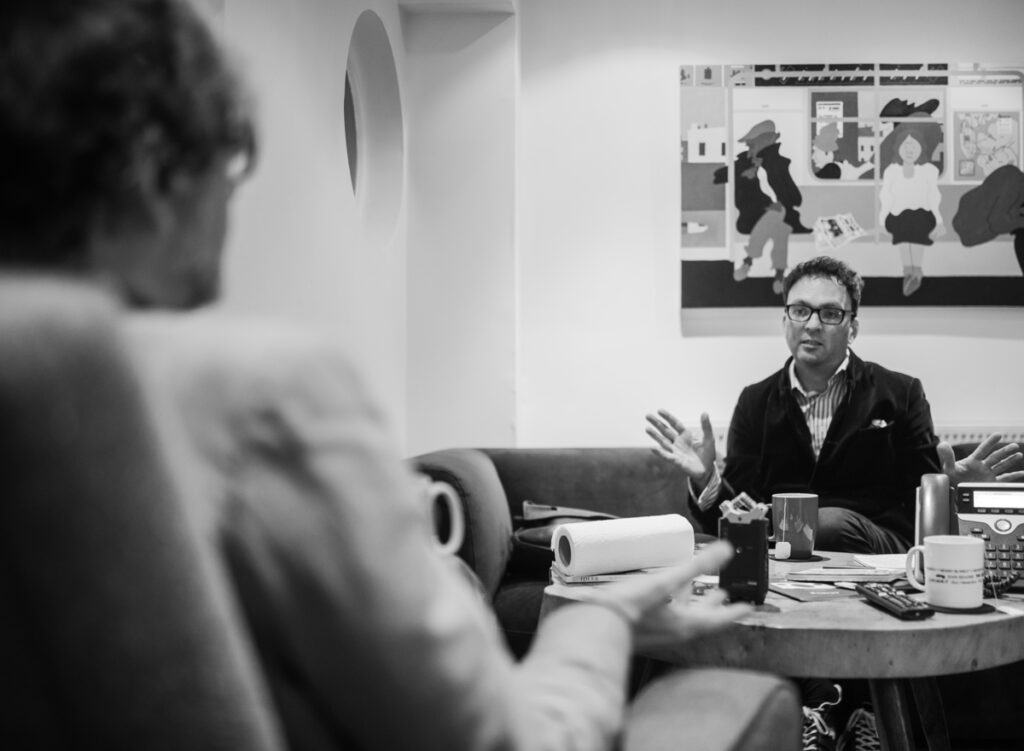
It’s a sunny day in old London town, and I’m due to meet Jarvis Cocker at the offices of Rough Trade, his record company, which are on Golborne Road in west London, in the shadow of Ernö Goldfinger’s 1972 modernist block of flats, Trellick Tower, and near the Paddington arm of the Grand Union Canal. It’s a lovely street with a decided Moroccan vibe as well as plenty of junk shops and Portuguese cafés. Jarvis appears from the basement and suggests we take a walk to a canalside sculpture garden he knows of to do the photos. “It’s called Gerry’s Pompeii,” Jarvis says in his deep, laconic, Sheffield voice. “Gerry, who made it, died a year ago, and there’s a campaign to save it.” We stroll across the iron bridge which crosses the railway coming into Paddington, past Trellick Tower and onto the canal path. This section of the canal is a bit scruffy and filled with boats whose occupants have found some sort of freedom in a harsh world. We see the sculpture garden on the other side of the canal. It is a very strange creation. It’s a narrow garden of around fifty feet. There is a line of statues, which look like something you might see by a roadside in Mex- ico, each commemorating someone who Gerry admired. “It’s outsider art – Gerry made the sculptures and put them there.” We cross the canal bridge and get into the garden by way of a neighbouring house whose occupants are involved in the campaign. It all seems characteristically Cock-eresque: Jarvis clearly has a deep interest in the outsider but also in the ordinary and every day. He has also clearly thought through the interview carefully – where to go for the pics, and what tea to drink. 

On our stroll back from this wonderful patch of eccentricity, Jarvis tells me how much he has enjoyed being in a band again, after many years as a solo operator. 

Back at the office, Jarvis makes the tea. It seems that he has lately become a tea entrepreneur. This is his own brand. It’s a mint tea developed with a company called Dragonfly. It’s called Beyond the Pale after his new album. The box says “welcome to the peppermint jungle” and describes the 

contents as a “blend of organically grown peppermint, ginger, lemon balm, fennel seed, spearmint and hemp seed.” We sit in the basement and drink it and chat about Jarvis’s new book, new band, being a slow worker and the difficulties of being an artist. 

Tom Hodgkinson: I heard you fell out of a window when young. What was the story? 

Jarvis Cocker: I was still living in Sheffield. It was 1985. I’d left school. The band started when I was at school. I’d always want to be in a band from the age of seven, from seeing The Monkees TV show on telly. They all lived in a house together and I thought that it looked like fun. They solved mysteries and wrote songs. I pretended that I was in a band even before I had one. You’d be walking around with a gang of friends and think yeah, I’m the singer, and he’s the drummer. Then a weird thing happened. 

The first demo that we recorded was done in a studio this guy had rigged up in his semi- detached house. You had to record in the bedroom and then mix it in the kitchen. 

John Peel came to Sheffield – he used to do these roadshow things. And I followed him out into the car park after he’d DJ’ed to give him a cassette of our first demo. 

TH: The classic indie band behaviour at the time! 

JC: Yeah, but then he did actually listen to it on the way home. And then, like about a week later, we got a phone call which our grandma answered. When I came back from school, my mum told me somebody had rung up about a John Peel session or something. 

TH: Oh my God. 

JC: I’d been listening to John Peel ever since just after the punk thing. That’d been my real musical education. So to be offered a session on the show was like… I was convinced that I was going to be a proper indie superstar. Before even leaving school! That emboldened me to decide to stay in Sheffield and try and make a career out of music. But it didn’t embolden the other members of the band who all went off to college, so I was kind of just left on my own. The falling-out- of-the-window incident was after I’d been in Sheffield and on the dole for maybe two or three years. Disillusionment was starting to set in. We were properly in the Thatcher years. It was obvious things weren’t going to get better very quickly. The falling-out-of-the-window thing was a bit like a mini lockdown, if you like. My life had been going on in a certain way. And then I found this window, and then I was in a hospital… 

TH: How did you fall out the window in the first place? At a party? 

JC: I was trying to show off in front of a girl. I was trying to do a stunt to impress her and it went wrong. 

TH: And how many floors up? 

JC: About three floors up. You get that kind of weird foreshortening effect, when you look down. “It’s not that far.” I was in hospital for two months. I had a lot of time to think about what I was doing with my life. I got moved to a convalescent hospital. I wasn’t in any danger anymore, but I wasn’t allowed out, I couldn’t put any weight on. I had fractured my pelvis. And then there were all these guys in there who’d had industrial accidents, because there still was some industry in Sheffield at that time. So I’m talking to these guys, and hearing their stories, and I found it really interesting. I’ve always credited that period with a real shift in my outlook. 

This is something that I’ve been trying to grapple with in this book that I’m trying to finish. It’s the idea that – I’m sure you have come across this a lot in your travels – a lot of people want to be artists, don’t they? 

They think it’s a great thing to go for. They want to express themselves, but then it’s like, how do you go about it? I’ve done talks at colleges and schools and people tend to ask you that question with a really pained look on their face. They think that maybe it involves moving to France and wearing a beret. And that fall, my literal fall from grace, brought me down to earth. It made me realize that the stuff that you should write about or use or paint about, is right under your nose. It’s the things that you’ve been brought up with. Because you’ve been brought up with them you discount them because… it’s like the furniture in your house. After a month, you don’t see it anymore. It’s just there. You sit on it. It’s funny that you asked me that question first. Because I do consider the falling-out-of-the-window thing to be a major turning point in my life. 

TH: Would you encourage someone, your own offspring, for example, to be an artist, full-time? 

JC: I would say, “you can do it,” because I do believe that everybody’s got that creative seed within them. But you also have to feel driven to do it. I came down to London to study filmmaking at St Mar- tin’s, and I thought that would be the end of the band. But we kept going, and it just kept nagging me, you know, and I kept writing ideas for songs and my work rate slowed down. I mean, it’s slow at any time, but it really slowed down… it got really, really slow. I wrote three songs in three years. 

TH: That is slow! 

JC: Yeah. But they were good ones! And then it just kept nagging me. I couldn’t quite let it go. And that’s what’s happened to me more recently as well. As we were walking back from the canal, I was tell- ing you that a member of the band died. And then I started doing the radio show [on BBC Radio 6 Music]. And I thought, “Oh, I really love doing that radio show,” so I thought, “well, maybe this is it now, this is what I’ll do.” But in the wee hours of the night, this little voice would say, “get on with what you’re supposed to be doing. You’re supposed to be a songwriter, get on with it.” You have to feel compelled to do it. There’s no guarantee that you’re ever going to make any money or make a decent life out of it. I think it would be ir- responsible to say, yeah, go on, everybody, you’re all gonna be successful artists. But if you feel compelled to do it, you can do it. 

TH: But it takes time. 

JC: On this latest record, there’s a song called “Swanky Modes”. That is where this tea we’re drinking comes from. There’s a line that says, “Welcome to the peppermint jungle.” So that’s why I thought we should have peppermint tea. That song was written with my son’s Rock School teacher. We were messing about with some ideas. And then this piece of music came out that really wasn’t kiddie at all, you know, this lovely piano thing. I recorded it but had no idea what the song was going to be about. When it came to writing the words for it, for some reason, this story came to mind. It was towards the end of me being at college – 1991. I was living in a street called Georgiana Street in Camden Town. That was living the dream for me, because when I first came down to London I thought Camden was the best place in the entire universe. Just up the road was a shop called Swanky Modes. This is a six month period of my life that happened nearly 30 years ago. But as soon as I started trying to write this song, it all came back in real and minute detail. 

Now, I can’t really say why that happened. But the fact is that for 29 years all this stuff had been in there and then suddenly it just formed into a lump that suddenly came out. I’m grateful for that. It’s kind of exciting because it’s like you’re giving your life a narrative. And I think that one of the privileges of being creative is that you get that chance to make it all make sense in retrospect. 

TH: That’s therapeutic as well. JC: Yeah. 

You process stuff that was painful at the time, or embarrassing.
And by getting a song out of it,
or a painting, or a book, that neutralizes it. It’s no longer a toxic thing in your life. 

TH: You remind me a bit of David Hockney. You have a similar sort of background, and that’s what he says – he likes to paint things that are right there in front of him. 

JC: I’d really like to meet David Hockney. I like his pro-smoking stance, even though I’ve kind of stopped smoking. He’s like the antithesis of me – I’m just always astounded by just how much work he makes and continues to make. He seems like he just gets up in the morning and just works. 

TH: I think he does, he works 24/7. But what is a typical day like for you, if you’re at home and working on your book? 

JC: I tried a few things out. When it came to it, the thing that I found mind blowing about writing a book was just how much you had to write. In songs you’re always trying to express something in the least number of words. 

TH And now you’ve got to write 70,000 words…

JC: So from that thing of trying to make every word count, you suddenly realise that you can’t write like that because it’s so irritating to read something that’s thing to make a point all the time. Its just like somebody who writes text in capital letters you know, it’s like “fucking back off. Give me some space!” So I thought, “how am I going to write all these words?” A friend who was writing books said, “I’ve been working with a secretary. I talk and she types it, and I’ve been getting 10,000 words a day.” So I went and tried that and that did work well. But then about three months ago. I just thought “fuck this”. It was in lockdown. I thought, “Well, come on. If you don’t write it now, you should just be put in jail.” 

TH: And your writing process? 

JC: So – 11 o’clock. Sit at the table. And you’ve just got to grind it out. There’s no way to make it pleasurable. And I’ll do it for at least two hours. Maybe have a break after two hours and then try and carry on. I wouldn’t probably go for more than four hours. Because you just get a bit brain- dead then. The book was called “This Book Is A Song” but now I think it might be called “Good Pop, Bad Pop”. I did a leaflet for Rough Trade Books that was called that. Pop was what formed me. 

TH: You’ve been talking about pop and The Monkees. But there’s also your other side, your avant-garde, Stuart Sutcliffe, Paris, Gauloises, Left Bank, black polo necks, existentialist philosopher side… 

JC: I don’t think that those things are mutually exclusive. 

That’s why The Beatles were
a big deal. For people from that background, to have the temerity to get into esoteric, Eastern religion and experimental music and to put that into pop music was an amazing thing.
And not just that they did it, but the fact that they did it and they were the biggest band of the time – that meant that everybody else wanted to have a go at it.
TH: It does seem to be much more difficult to be bohemian these days.
JC: Yeah. I agree it is. When I first came to London a friend said, ‘Well, we’re squatting in this tower block in Camberwell, come and take the flat underneath us.” That was an option. And it was a bit scary sometimes, because the council used to come around with a big metal door and pretend that they were going to like seal you insde. It’s pretty obvious they weren’t going to do that but they would try anything to try and scare you out of there. I remember going to a squatters’ help centres, somewhere behind kings cross. You could go along and get advice on what to do and how to get the electricity put back on and stuff like that. 

TH: So lockdown has actually been quite good for your book? 

JC: Yeah, I’m aware of being in very privileged position in lockdown because I had somewhere up North quite near where my mum and sister still live in Sheffield. I moved up there and I kind of had a good time. The record came out. So for me, it was OK. 

TH: Is it quite rural? I mean, are you going for like long walks in Peak District and things like that? 

JC: It went very quiet and rare animals came back, because they weren’t being disturbed by traffic. There are all these hopes that we could learn from that. And I do think that it’s got to have a profound effect – just the fact that everybody’s had to pause their normal life. It’s like me lying in the bed in hospital. After falling out of the window, I got to thinking about what is important in life and what isn’t. People really have realized is that life is boring if you can’t hang out with other people. And we’re talking about creativity, we’re talking about people making things. Over the past few years, with streaming and so on, people have tended not to go out so much. They’ll stay at home and consume culture in their living room. And then when lockdown happened, as soon as you were forced to stay in your living room, everybody thought, ‘oh fuck, I’ve got to go out!’ When you’re cut off from the source of life… Without that wellspring, then it kind of seems a bit pointless. 

TH: As far as I know, there haven’t been any great songs about Zoom meetings yet. 

JC: And there never will be… Maybe I’ll take that on as a commission. 

TH: Your song “Must I Evolve”? Is it about the pressure of having to do things? 

JC: I felt that I had to not change but evolve. I prefer the word evolve because you’re the same person or entity but you’ve mutated into a different shape. It sounds

much better than ageing. That song’s also about trying to tell the story of a relationship. I came up with this idea that, when you meet someone, that’s like two single cells. Then these two cells fuse, and you get multicellular organisms. Some friends get married, and it works, and they grow, and it turns into this great thing, and you always want to go around to their house, and it’s great. Other friends get married, and it’s like, it doesn’t really work. You know, it doesn’t evolve. And you don’t want to go round because it’s always a bit awkward. So, once that chain reaction starts, you don’t really know where it’s going to evolve to. And as I was telling you,

on the way back from the canal, one of the big things about this band has been to let other people into the process. Because that’s what gets evolution going. If you’re trying to control it all the time, it’s a bit of a mean way of doing things.

TH: That sort of suggests that you’ve been more egotistical and controlling at certain points in the past?

JC: Oh, yeah.
TH: You haven’t been immune to the seductions of pop star ego?

JC: I think it’s pretty impossible.

I mean, just to go on stage and say, “Look, I’m the focal point of this whole room” is an ego statement. And then when everybody agrees and goes, “yes, you are!” And claps, then it’s pretty hard to avoid the ego pitfalls. Yeah.

TH: Some performers say, “I’m only ever happy when I’m on stage”, that Morrissey thing. Is that partly true with you?


JC: I’m happy then – and sometimes even in real life as well – but I do think there is something in that idea that being on stage is to be like being in the zone. All those Eastern religions are about getting to that place you’re inhabiting the present. And the thing is that sometimes on stage, you really do reach that moment.

TH: Well, you’re sort of godlike. And you probably say and do things that you didn’t know you were capable of.

JC: I can never remember much about concerts afterwards. You only really re- member ones when something went wrong. Good concerts just seem to pass by in five or ten minutes, and you’re not really aware of it.

TH: Have you stopped drinking? What about that side of things? Some of my friends in their fifties are rediscovering magic mushrooms.

JC: Magic mushrooms were the first drug I ever took because they’re quite plentiful up in Sheffield. Towards the end of school, we used to go and pick them in these fields on the edge of town. I probably had them too much when I was younger, so I’ve kind of avoided them. I know they’ve had a bit of renaissance recently. I’ve got friends who’ve gone through 12-step programs. I’ve not done that. I do still drink. Like a lot of people, probably my drinking increased in lockdown because it was a way of providing some punctuation to the day. We tried to wait until six at least… I don’t really smoke anymore. Maybe if I’m having a drink, I might share a cigarette.

TH: You might have the odd rollie or something?

JC: Yeah. So not very exciting. I’m sorry.